
Quoted from the Ministry of Religion website
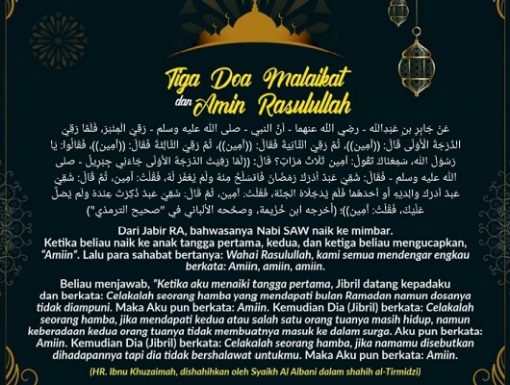
From Jabir RA, that the Prophet SAW ascended the pulpit. When he went up to the first step, second, and thirdly he uttered, "Amen". Then the friends asked: O Messenger of Allah, we all hear you say: Amen, amen, amen. He answered, ”When I climbed the first stairs, Jibril came to me and said: Woe to a servant who finds the month of Ramadan but his sins are not forgiven. So I said: Amen.
Then He (Jibril) said: Woe to a servant, if you find both or one person his parents are still alive, but the presence of his parents did not make him enter into heaven. I said: Amen.
Then He (Jibril) said: Woe to a servant, if your name is mentioned in front of him but he not praying for you. So I said: Amen.
(HR. Ibn Khuzaimah, Authenticated by Shaykh Al Albani in Sahih al-Tirmidhi)
Explanation of Hadith
This hadith explains about the angel Jibril's prayer regarding three bad practices for which the reward is amen directly by the Prophet SAW.
The phrase “Woe a servant” has at least two meanings, that is: expression of hatred against people who neglect to take advantage of opportunities to achieve abundant goodness and the bad ethics of a Muslim towards a figure or something that is glorified by Allah SWT.
Object of conversation Angel Gabriel AS with the Prophet SAW in this hadith is the month of Ramadan, both parents, and Rasulullah SAW who has glory with Allah SWT.
Glorifying the month of Ramadan
The sentence “Woe a servant who finds the month of Ramadan but his sins are not forgiven", explain the glorious side of Ramadan as a month full of forgiveness, month full of grace, month full of guidance, month of good harvest, and which month returning humans to nature.
But ironically, no Few Muslims have passed the month of Ramadan but their souls are fitrah not coming back, rather "stupid" in immorality and bad morals without tap goodness. Therefore, The angel Gabriel immediately gave the title "wretched".
In some hadiths, The Prophet SAW explained the special features of the month of Ramadan that are not owned other months. One of them is a hadith from Abu Hurairah RA, he said; The Prophet SAW said: "Every good deed of the son of Adam is multiplied by its reward. One good deeds are rewarded ten to seven hundred times. Allah 'azza wajalla said; "Except fasting, because fasting is for Me and I am it which will give him a reward. Reason, he has abandoned lust and lust His appetite is because of Me." And people who fast get two happiness, (that is) happiness when breaking the fast and happiness when meeting with His Rabb. Indeed, the smell of the mouth of a person who fasts is more fragrant in the sight of Allah than the fragrance of musk.” (HR. Muslim).
Ramadan opens the door forgiveness of sins as wide as possible. Fasting worship and worship at night done with full faith is the main factor in the forgiveness of sins. As the Prophet SAW said from Abu Hurairah RA,
“Whoever fasting (on the Moon) Ramadan with full faith and hope (reward), then he will be forgiven for his past sins". (Sahih hadith narrated by Bukhari and Muslim)
Honoring Parents
The sentence “Woe a servant, if both or one of their parents are still alive, But the presence of his parents does not make him enter heaven." explains the noble side of parents who must be treated well all his life. The noble side of the old man is confirmed with a guarantee heaven for a child who is faithful to make him happy and take care of him until the end life
In plain terms, Al The Qur'an explains two commandments that must go hand in hand and cannot separated, namely the command to worship Allah and apply ihsan to both parents and the command to thank Allah and both parents. As the word of Allah SWT;
“And your God has commanded that you should not worship other than Him and should do good to parents….” (QS. Al-Isra: 23)
The order applies ihsan and thanking both parents is an unlimited obligation, namely regardless of the age limit of the parents, even though both of them have died then the order it remains inherent in a child, of course in form continue the goodness of both, pray, or charity for both of them.
In a hadith, once Upon a time, a friend named Jahimah once came to the Prophet and said, “O Messenger of Allah, I want to join the war and I came to you to ask for advice". The Prophet asked, "Do you still have a mother??" "Yes, Still,he answered. So he said, "In that case, accompany him, because Heaven lies at his feet." (HR. Ahmad).
So, glorify parents and caring for them is the main thing. Even equivalent to jihad (war) in the way of God. On the contrary, a Muslim who does not honor people old, reluctant to take care of him, and is reluctant to pray for the two of them, his life will definitely happen far from blessing. As in the hadith,
From Anas bin Malik RA, The Messenger of God said: "When someone refuses to pray for both parents, then the child's sustenance in the world will undoubtedly be cut off." HR. Ad-Dailamy
Preference of Shalawat
The sentence “Woe a servant, if your name is mentioned in front of him but he does not pray for you" explains the importance of reading blessings to the Messenger of Allah. As a people, we must thank him for his struggle and ethics good by praying when his name is mentioned. Blessings every time saying the name of Prophet Muhammad SAW cannot be taken lightly, because that's where it is quality love we to him.
The command to pray has its own glory in the Qur'an, that God and the His angels always bless and order Muslims to pray. This is stated in the Al-Qur'an surah Al-Ahzab verse 56:
“Indeed Allah and His angels bless the Prophet. O people who believe! Pray for the Prophet and greet him fully respect to him.” (QS. Al-Ahzab:56)
Based on this verse The scholars agreed that the law of blessing the Prophet Muhammad SAW is obligatory for every believer. Ibnu Abdil Barr as quoted by Sheikh Yusuf bin Ismail An-Nabhani said that the ulama had agreed that Salawat to the Prophet SAW is obligatory for every believer based on this verse.
Praying is expressions of love, recognition of the results of the struggle, and hope for his intercession in the last days. Bershalawat can be done without being bound by time and place, even when relaxing can pray.
In the book of Al Fawaid Al Mukhtaroh, Shaikh Abdul Wahhab Asy Sya'roni narrated that Abul Mawahib Asy Syadzily said: I once dreamed of meeting His Majesty the Prophet Muhammad SAW, I asked "There is a hadith that explains the ten blessings of God given to people who like to recite shalawat, Is it a condition that when reading you have to with the heart present and understanding the meaning?” Then the Prophet replied “No thus, the reward is given to anyone who blesses me even though his heart is negligent."
So hopefully it's useful.
Subhan Nur, Lc, M.Ag
(Head of the Da'wah Methods and Materials Development Section, Dit. Explanation of Islam)
Writer : There is no country